 Uniswap
 Swap Example With Clear Stop Points
A Uniswap swap quote can change until you sign an order or submit a transaction. For one bounded attempt, match the selected network and token identifiers, enter the intended amount, and read the quoted output, price impact, minimum output, route, and network cost. Stop before authorizing any wallet request if a term no longer fits. When the quote refreshes, treat the new figures as a new offer and review them before deciding whether to continue.
Route Options Behind the Quote
The route behind a quote can use one or more Uniswap protocol pools, while third-party fillers compete to execute an eligible UniswapX order. Default routing weighs expected output alongside estimated network cost and available liquidity; constraining the route narrows those choices. A direct pool swap and a filler-based order can require different permissions and handle network costs differently. Compare the route, quoted output, minimum output, price impact, and cost treatment as one set of terms.
The Stop Decision Before Wallet Authorization
A review before any new authorization is the cleanest stop point because no new approval, signature, or swap transaction has been submitted. Connecting a wallet lets an interface read public account data and prepare requests, but connection alone does not transfer tokens.
- Confirm that the selected network matches the intended token balances.
- Match each token contract or mint address, not only its displayed symbol.
- Check whether the route requires a separate token approval.
- Read the minimum output alongside the larger quoted output.
- Leave enough of the network token for user-paid onchain actions.
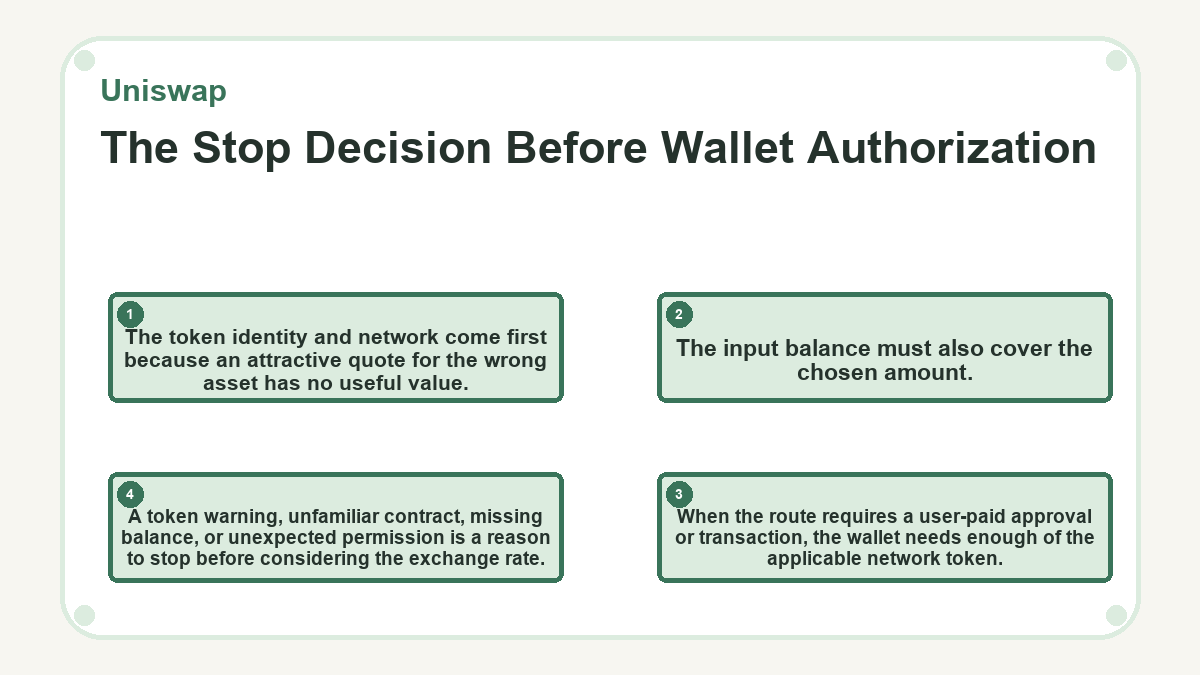
The token identity and network come first because an attractive quote for the wrong asset has no useful value. The input balance must also cover the chosen amount. When the route requires a user-paid approval or transaction, the wallet needs enough of the applicable network token. A token warning, unfamiliar contract, missing balance, or unexpected permission is a reason to stop before considering the exchange rate.
Stop when its minimum output falls below the amount that would still satisfy the intended exchange, when price impact becomes unacceptable, or when the route changes to one that requires unfamiliar permissions. Changing the amount, slippage setting, and route together makes the cause of a new result harder to identify. A bounded retry changes one input, obtains a fresh quote, and repeats the review.
How Does One Bounded Swap Play Out?
This worked example uses only hypothetical values. The input amount, output figures, percentages, cost figures, and acceptance threshold are invented for this example. The unnamed input token, output token, and network are placeholders.
Entry: Record the Intended Exchange
The intended swap begins with matching token identifiers and one selected network. The reader enters 2.38 units of the input token. The first quote offers 146.7 output units, shows 0.6% price impact, lists a minimum output of 145.4 units, and estimates a network cost of 0.0048 network-token units. The reader will proceed only if the minimum output is at least 60.9 output units per input unit and the displayed route and permissions remain unchanged. No wallet request has been authorized.
Transition: Check the Refreshed Terms
The quote refreshes before authorization because liquidity, routing, or network conditions have changed. It now offers 143.9 output units, shows 1.4% price impact, lists a 142.7-unit minimum, and estimates a 0.0053-unit network cost. The route has changed as well. Its minimum output is about 60.0 units per input unit, below the recorded acceptance test. The reader stops without widening slippage or signing the changed request.
Exit: Change One Input and Retry
The retry changes only the input amount, reducing it from 2.38 to 1.58 units. A fresh quote offers 97.1 output units, lists a 96.3-unit minimum, shows 0.5% price impact, and returns to the expected route. The minimum now exceeds 60.9 output units per input unit. After the wallet request matches those terms, the reader authorizes it. The completed record shows 96.5 output units received, above the stated minimum.
Price Impact, Slippage, and Minimum Output
Price impact, maximum slippage, and minimum output answer different questions, so one favorable number cannot substitute for the other two.
Price Impact and Trade Size
Price impact is the change in token price caused by the swap itself. A larger input relative to available liquidity generally moves a pool price farther, although routing across liquidity sources can alter the displayed effect. This figure belongs to the proposed trade and does not predict later market movement. If price impact rises after a refresh, the same input is meeting different liquidity or routing conditions.
Slippage Bound and Minimum Output
Maximum slippage controls how much worse a direct pool swap may execute relative to its quote before the transaction reverts. A tight limit can cause an otherwise acceptable swap to revert, while a wide limit permits a broader range of execution outcomes. For an eligible UniswapX order, the interface displays a minimum output instead of an adjustable slippage setting. In either case, minimum output is the clearest stop boundary because it states the least output that the reviewed terms permit.
Wallet Requests, Permissions, and Costs
Wallet prompts separate permission from execution, and every prompt should match the quote that remains under review.
Token Approval Scope
An ERC-20 input may require an onchain approval before a swap contract can transfer it. The approval establishes an allowance; it does not complete the exchange. An exact allowance restricts the approved amount but may require another approval for a later swap. A larger allowance reduces repeated approvals while leaving more spending authority active. The token, spender, amount, and network in the wallet request must match the intended action before approval.
Signature and Transaction Details
A Permit2 signature can authorize a protocol to spend tokens under an existing onchain approval to Permit2 without requiring another onchain transaction. That signature still authorizes token spending within its stated amount and time limit. A swap transaction request goes further by asking the wallet to submit execution to the network. An unexpected spender, token, amount, network, or deadline changes the request, even when the interface still displays the original quote.
Submitted Costs and Bounded Failure
A submitted onchain transaction can incur a non-refundable network cost even when execution fails. The network has already processed the request far enough to determine its outcome. Rejecting a wallet prompt before broadcast is different because no transaction reaches the network. A failed direct swap therefore calls for a fresh quote and a review of the failure cause, not an automatic increase in slippage.
For an UniswapX order, a filler pays most swap network costs on the user's behalf and factors them into the offered price. Initial onchain token approval can still cost the reader, and wrapping a native network token can require an onchain action. An order that cannot be filled should be quoted again rather than treated as proof that a direct pool swap would fail for the same reason.
A Deliberate Exit Record
The exit record should distinguish a stopped attempt from a completed one. A stopped attempt keeps the network, token identities, input, rejected quote, and reason for stopping. A completed attempt adds the accepted route, transaction hash or order record, minimum output, recorded cost, and final balance change. Separate records keep an expired quote distinct from a later retry and show whether the accepted terms produced the intended output.
Uniswap questions, answered
-
Does a Uniswap Quote Reserve Liquidity While I Review It?
- No. A displayed quote does not reserve pool liquidity or freeze routing conditions while it remains on screen. Other transactions, liquidity changes, and network conditions can alter the expected output, price impact, route, or cost before authorization. If any displayed term refreshes, review the full quote again and use the new minimum output as the decision boundary.
-
Can I Retry the Same Input After a Slippage Failure?
- Yes, but the retry needs a fresh quote and a new review. A reverted onchain transaction may already have consumed a network cost, but it produces no swap output. Check whether the quote changed, the deadline expired, the token applies transfer fees, or the allowance was insufficient before changing the slippage limit.
-
Why Can a Token Transfer Fee Break the Quoted Route?
- A token-level transfer fee changes the amount that reaches or leaves a swap route. That difference can make the router's expected input or output inconsistent with the token contract's actual behavior, causing some transactions to revert. Variable fees make the result harder to bound because a previous successful setting may not describe the next transfer. A wider slippage limit does not correct every unsupported token behavior.
-
When Does Splitting a Swap Into Smaller Attempts Help?
- Splitting can reduce the price impact shown for each individual attempt when the input is large relative to available liquidity, but it does not guarantee a better combined result. Repeated swaps can traverse the same liquidity curve and incur multiple network costs. Default routing may also split one quote across liquidity sources, so compare total minimum output and total cost before adding transactions.
Updated ·