 Uniswap
 fee tiers shape swap pricing and route selection
Uniswap fee tiers determine the liquidity-provider charge applied inside each pool, while routing compares that charge with active liquidity, price impact, and network cost. A lower percentage does not automatically return more tokens because a deeper, higher-fee pool can support a stronger final quote after all route costs are included.
The best route balances each pool's fee against active liquidity, price impact, and network cost before comparing final token output.
Cost Components That Change the Quoted Output
Four cost components determine whether a fee tier is economical for a particular swap: pool fees, price impact, route structure, and network cost.
For a standard pool, the fee comes from the amount entering that swap hop. The pricing curve then uses the remaining input to calculate output. In symbolic terms, the effective pool input is the stated input multiplied by one minus the fee rate. That relationship shows the direction of the fee effect, but it cannot determine the final quote alone.
Price impact comes from moving along the pool's pricing curve. It depends on the swap size relative to available liquidity. In concentrated-liquidity pools, only liquidity active around the current price supports execution. A lower fee can therefore be outweighed by a larger price movement through a thinner pool.
Maximum slippage serves a different purpose. It sets the least favorable execution that the transaction may accept relative to the quote. Changing that bound does not improve pool liquidity or reduce the fee tier. It only changes the point at which an unfavorable state change causes execution to fail.
Network cost sits outside the percentage charged by each pool. An extra hop or split path can improve pricing, yet it also adds execution work. Routing compares that additional cost with the extra token output. The relevant comparison is the complete quoted result, not one percentage viewed in isolation.
How Can a Higher Fee Pool Produce a Better Quote?
A higher-fee pool can produce a better quote when its active liquidity reduces price impact enough to offset the larger fee deduction.
Liquidity Depth and Price Impact
Active liquidity determines how far a swap moves the pool price. A lower-fee pool with thin liquidity may return fewer tokens because the trade moves farther along its curve. A pool charging more can still win the comparison when it holds enough liquidity near the current price to keep that movement smaller.
Multi-Hop Route Economics
A multi-hop route introduces an intermediate token and at least one additional pool. Routing uses it only when the combined output remains favorable after every fee and added network cost.
Fees at Each Hop
Each hop applies the fee configured for its own pool. The second pool receives the output of the first hop, not the route's original input. Fees therefore accumulate through sequential calculations rather than as one percentage applied once to the starting amount.
Network Cost and Net Output
Network cost can reverse an apparent pricing advantage. A longer route may produce more output before execution cost, yet leave less economic value after that cost is included. Split routing follows the same logic: each branch must improve the combined quote enough to justify its extra execution work.
From Candidate Pools to a Route Quote
A consistent route comparison holds the token identifiers, selected network, input amount, and slippage setting constant. The router can then compare a direct action with a multi-hop action using the same dimensions: pool fees, price impact, estimated network cost, and expected output. These inputs remain editable before wallet confirmation.
This sequence describes classic pool routing. An order filled through UniswapX follows a different execution and cost path, so compare its displayed terms separately.
| Stage | Cost Input | Observable Evidence | Route Condition or Limit |
|---|---|---|---|
| Set the comparison inputs | Token identifiers, network, input amount, and slippage bound | Direct and multi-hop candidates start from the same request | No wallet confirmation has occurred, so every input remains editable |
| Discover pools | Pool version, fee setting, and active liquidity | The router identifies reachable direct and intermediary paths | Unavailable, filtered, or unsimulatable pools cannot support the quote |
| Simulate a direct path | One pool fee and the pool's price movement | Expected token output and estimated network cost | A direct path contains one swap hop |
| Compare added paths | Every pool fee, price impact, and added execution cost | Net output from multi-hop or split candidates | An added path helps only when its improvement exceeds its added costs |
| Submit and reconcile | Selected route and minimum output | Transaction status and resulting token balances | The minimum output is the execution floor; a lower result causes a revert |
In classic routing, the router can compare liquidity across Uniswap v2, v3, and v4 while accounting for pool fees and network cost. The selected path may split the input, use intermediate tokens, or remain direct. After submission, transaction status and resulting balances show whether execution matched the accepted route. A reverted attempt requires a fresh quote because the earlier pool state may no longer apply.
Which Fee Tier Fits a Token Pair?
A suitable fee tier matches the pool's active liquidity and trading conditions rather than simply offering the smallest percentage. Default routing can compare available pools without requiring a manual tier choice. Liquidity providers make a different decision when selecting or creating a pool: a lower fee may attract flow, while a higher fee collects more per unit swapped. Existing liquidity, expected price movement, competing pools, and the position's chosen range all affect that trade-off.
Version Boundaries for v2, v3, and v4
Protocol version determines whether a pool has one fixed fee, one of several fixed tiers, or a configurable fee design.
v2: One Pool Fee
Uniswap v2 charges a 0.3% fee on swaps in every v2 pool. The fee increases pool reserves and affects the value represented by liquidity tokens. If a protocol fee is enabled, the v2 contracts account for its share by minting liquidity tokens when liquidity is added or removed, not by increasing the swap's 0.3% charge. For route comparison, v2 does not offer alternate fee tiers for the same token pair.
v3: Four Fixed Tiers
Uniswap v3 supports four fee tiers: 0.01%, 0.05%, 0.3%, and 1%. Each combination of token pair and fee tier forms a separate pool. Concentrated liquidity means those pools can have very different active depth near the current price, even when they contain the same two tokens.
v4: Static and Dynamic Choices
Uniswap v4 does not inherit v3's four-value restriction. A v4 pool can use a custom static fee, while a pool configured for dynamic fees can update its fee through authorized hook logic. Hooks can also change swap execution or charge a separate hook fee. Routing must therefore evaluate the simulated output and pool behavior rather than treating a v4 fee label as a complete cost description.
What Happens When a Fee or Liquidity Change Invalidates a Route?
A changed pool fee or liquidity state makes the earlier quote stale, so routing must simulate the available paths again. Dynamic fees, intervening swaps, and shifts in active liquidity can change which pool or path offers the strongest output. A quote does not reserve the state used to calculate it.
A refreshed quote may show a different route, minimum output, or expected network cost. Before submission, the reader can keep the original input fixed and compare those changed terms. After submission on an EVM network, failure to meet the minimum output normally reverts the swap, although network gas can still be charged. Recovery starts with a new quote rather than an assumption that the rejected route remains available.
Reading Fee Evidence Before Commitment
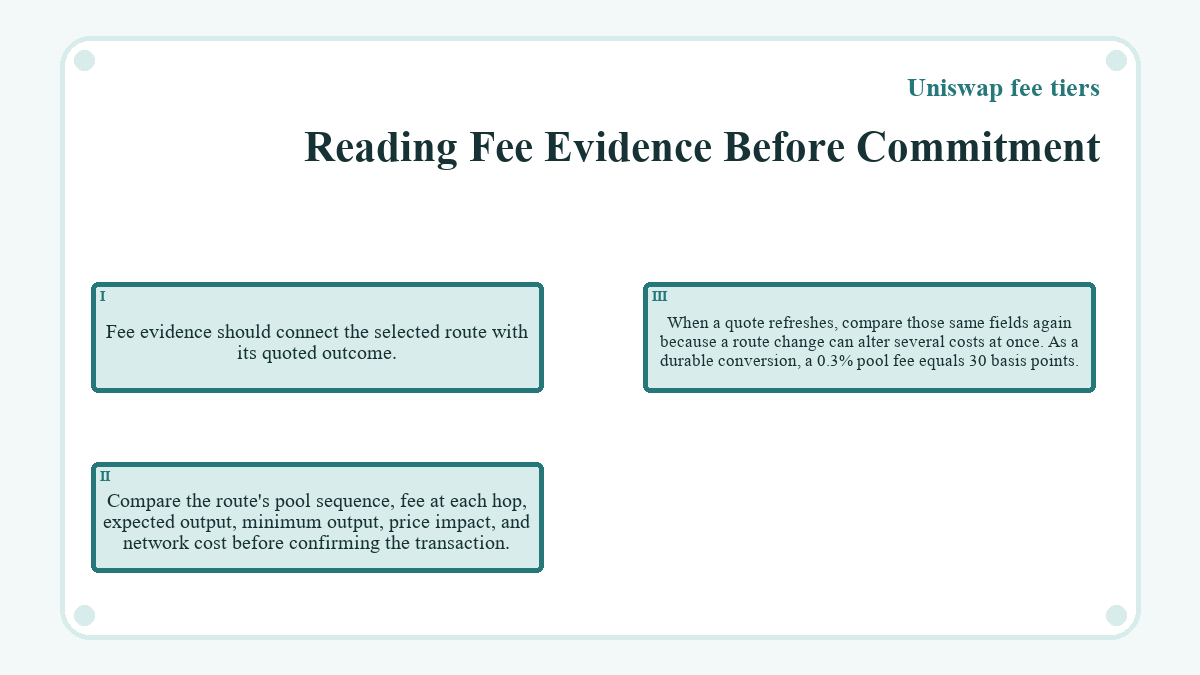
Fee evidence should connect the selected route with its quoted outcome. Compare the route's pool sequence, fee at each hop, expected output, minimum output, price impact, and network cost before confirming the transaction. When a quote refreshes, compare those same fields again because a route change can alter several costs at once. As a durable conversion, a 0.3% pool fee equals 30 basis points.
Practical questions about Uniswap fee tiers
-
Are Pool Fees Charged When an EVM Swap Reverts?
- A reverted EVM swap does not retain the pool fee because the token exchange and pool-state changes roll back. The sender can still pay network gas because the network processed the failed transaction. A rejected quote before submission has no onchain cost, while a submitted failure has a transaction record that distinguishes it from a completed swap.
-
Does Concentrated Liquidity Earn Fees While It Is Out of Range?
- A concentrated liquidity position does not earn swap fees while its range excludes the pool's current price. In v3 and v4, the position becomes single-sided after the price moves beyond its selected range. The position resumes earning fees if the price returns to its range. Otherwise, the provider must remove and redeploy liquidity in an active range to earn fees from that capital.
-
Can a Split Route Use Different Fee Tiers?
- A split route can use pools with different fee tiers across its branches or hops. Each portion pays the fee of every pool it traverses, and the router combines the resulting output. Splitting helps only when access to additional liquidity reduces price impact enough to cover those pool fees and the added network cost.
-
Can Forcing a Single Protocol Version Change the Quote?
- Restricting a quote to one protocol version can change both its route and token output. The restriction removes liquidity from other versions from consideration, which may eliminate a deeper pool, a lower-impact split, or a shorter path. The resulting quote should be compared on expected output, minimum output, and network cost under the same input.
-
When Do Uniswap v3 Fees compound Into a Liquidity Position?
- Uniswap v3 fees do not compound into position liquidity automatically. The protocol tracks earned fees separately from active liquidity. A provider can collect those tokens without removing the position and may add them through a separate liquidity action. Until that action occurs, the claimable fees do not increase the position's active earning base.
Updated ·